


Pretoria has unveiled a major pivot in its fight against foot-and-mouth disease (FMD): a national strategy explicitly framed as “FMD-free with vaccination,” backed by mass vaccination starting in early February 2026, tighter movement enforcement, expanded laboratory capacity, and a push for livestock identification and traceability.
A shift driven by scale and economic pressure
FMD is among the most disruptive animal diseases for livestock value chains because it spreads rapidly and can trigger immediate market restrictions. The World Organisation for Animal Health (WOAH) classifies FMD as a listed disease and notes it must be reported to the Organisation.
In South Africa, the disease is reported as active in seven provinces, with KwaZulu-Natal (KZN) repeatedly cited as the epicentre.
What the plan includes: targets, phases, and enforcement
In its 18 December 2025 statement, the South African government sets measurable goals for the next two years, including:
- ~70% reduction in FMD incidents in high-risk areas over 24 months;
- 90% vaccination coverage in target populations (communal areas, commercial farms, feedlots);
- 100% vaccination coverage in dairy cows;
- the establishment of certified compartments and progressive vaccination zones to support safer trade.
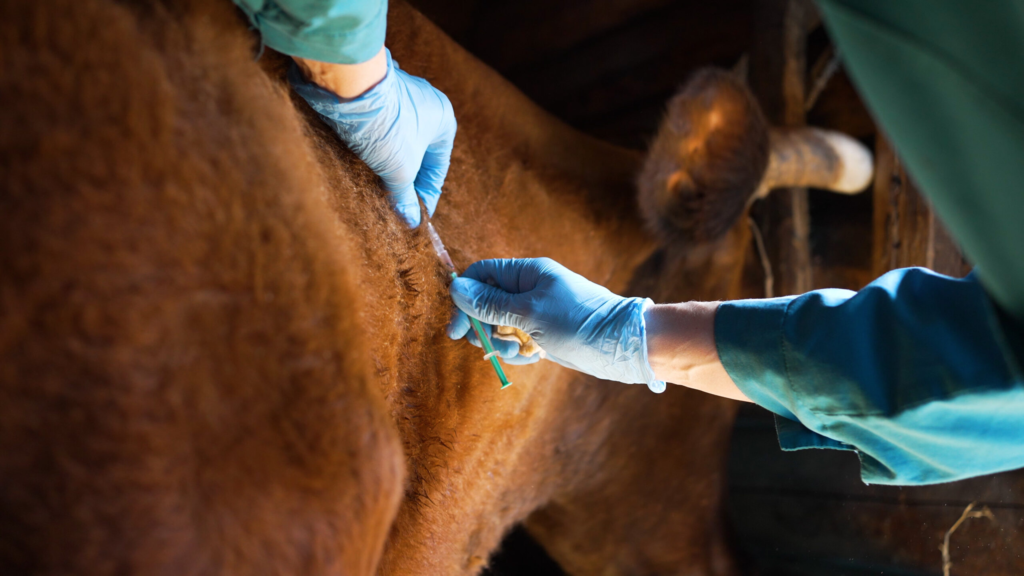
The vaccination campaign is already underway at limited scale: close to 950,000 animals have been vaccinated in recent months using government-procured stock.
Mass vaccination is scheduled to begin in early February 2026, starting with KZN and Gauteng, then Limpopo and Mpumalanga, and later North West and Eastern Cape. Authorities also flag an “urgent need” for protection zones to safeguard FMD-free areas, including Eastern Cape, Northern Cape and Western Cape.

Implementation will not rely on veterinary services alone. The government states it will work with SAPS and other law-enforcement agencies, with briefings planned for the third week of January, and it will train and deploy unemployed animal-health graduates to support roll-out.
Vaccine supply: BVI and a domestic production push
Vaccine availability is central to credibility. The government indicates the Botswana Vaccine Institute (BVI) has confirmed it can supply 1,000,000 doses per month from mid-January 2026, enabling accelerated vaccination in critical areas.
On the domestic front, the Agricultural Research Council (ARC) is advancing a mid-scale manufacturing facility, with targets that include 20,000 multivalent doses by Q4 of 2025/26 and 150,000–200,000 doses by Q1/Q2 of 2026/27.
Diagnostics and surveillance: the other half of the equation
South Africa also plans to strengthen diagnostic throughput. The government states diagnostic capacity at the Onderstepoort Veterinary Laboratory will be increased via additional veterinary technologists and by leveraging other laboratories; diagnostic kits and vaccines may be imported “as and when required.”
KZN illustrates why this matters: TimesLIVE reports 207 confirmed outbreaks in the province, with a portion officially closed with WOAH, but many unresolved—underscoring the operational challenge of moving from outbreak management to sustained control.
Why WOAH standards sit at the core of “FMD-free with vaccination”
South Africa’s framing is not just political messaging—it mirrors the language of international animal health governance.
1) FMD is a WOAH-listed disease with reporting obligations
WOAH explicitly states that FMD is a listed disease and must be reported, and the Terrestrial Code’s Chapter 1.1 lays out requirements for notification and epidemiological information-sharing via WAHIS.
2) “Free with vaccination” is built on defined technical criteria
WOAH’s Terrestrial Code Chapter 8.8 provides the disease framework for infection with FMD virus, including how infection occurrence is defined for susceptible animals.
3) Official recognition follows a structured application pathway
WOAH’s Chapter 1.11 sets out the information Members should provide when applying for official recognition of FMD-free status, including provisions for a zone where vaccination is practised that is free from infection with FMD virus in line with Chapter 8.8.
4) Zoning, compartments and traceability are not optional add-ons
WOAH’s Chapter 4.4 explains the principles of zoning and compartmentalisation and how trading partners may recognise subpopulations with specific health status.
WOAH’s Chapter 4.2 positions animal identification and traceability as tools that strengthen vaccination programmes, movement controls, surveillance and outbreak management—exactly the ecosystem South Africa is trying to build.
Key dates and numbers (at a glance)
- Mid-January 2026: BVI supply capacity cited at 1,000,000 doses/month
- Second half of January 2026: law enforcement briefings planned
- Early February 2026: mass vaccination starts (KZN + Gauteng first)
- Already vaccinated: ~950,000 animals (recent months)
- Targets (24 months): ~70% incident reduction, 90% coverage in target populations, 100% dairy
AfricaVET take: what this signals for the continent
South Africa’s strategy reinforces a practical lesson for African livestock systems: vaccination alone does not restore market confidence unless it is paired with (1) enforceable movement rules, (2) traceability that proves where vaccinated animals are, and (3) laboratory capacity that confirms, maps and documents the trajectory of outbreaks.
As Minister Steenhuisen cautioned, the ambition is long-haul: “a monumental task… [with] a long road ahead.”