


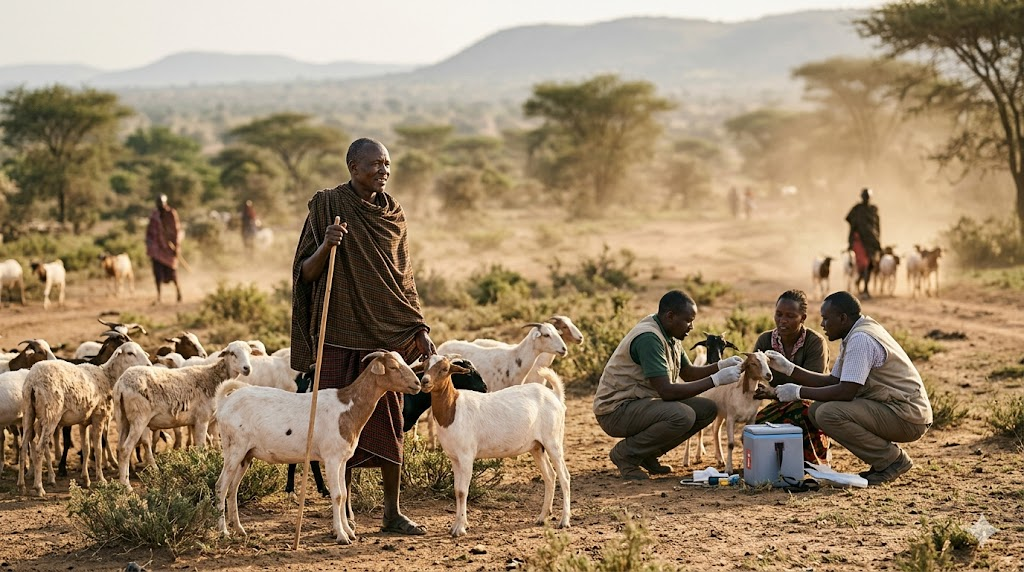
Arusha, Tanzania — For many livestock keepers, borders exist on maps, but not always in daily life. Goats and sheep move with families, traders, markets, pasture and water. Along these same routes, diseases can also move.
This reality was at the heart of a regional workshop held in Arusha, Tanzania, from 27 to 30 April 2026, where countries from Eastern Africa and the Great Lakes Region came together to strengthen the fight against Peste des Petits Ruminants, commonly known as PPR.
The meeting focused on two closely linked priorities: using the episystem approach to better understand where and how the virus circulates, and strengthening cross-border coordination so that countries can act together rather than in isolation.
Looking beyond administrative borders
PPR remains a serious threat in parts of Eastern Africa and the Great Lakes Region. The disease affects goats and sheep, which are central to food security, household income and resilience for millions of rural and pastoral families.
But controlling PPR requires more than drawing lines around districts or provinces. The virus follows animal movements, livestock markets, trade routes, grazing corridors and cross-border production systems.
That is why the episystem approach is increasingly important. It helps countries identify the real transmission systems that allow the virus to survive and spread. With this information, veterinary services can better target vaccination, strengthen surveillance and use data to guide action.
In simple terms, the goal is no longer to vaccinate everywhere in the same way. The goal is to focus efforts where the risk is highest and where intervention can have the greatest impact.
Countries working toward one goal: PPR eradication by 2030
The workshop brought together participants from Burundi, Djibouti, the Democratic Republic of Congo, Kenya, Rwanda, Somalia, South Sudan, Sudan, Tanzania and Uganda.
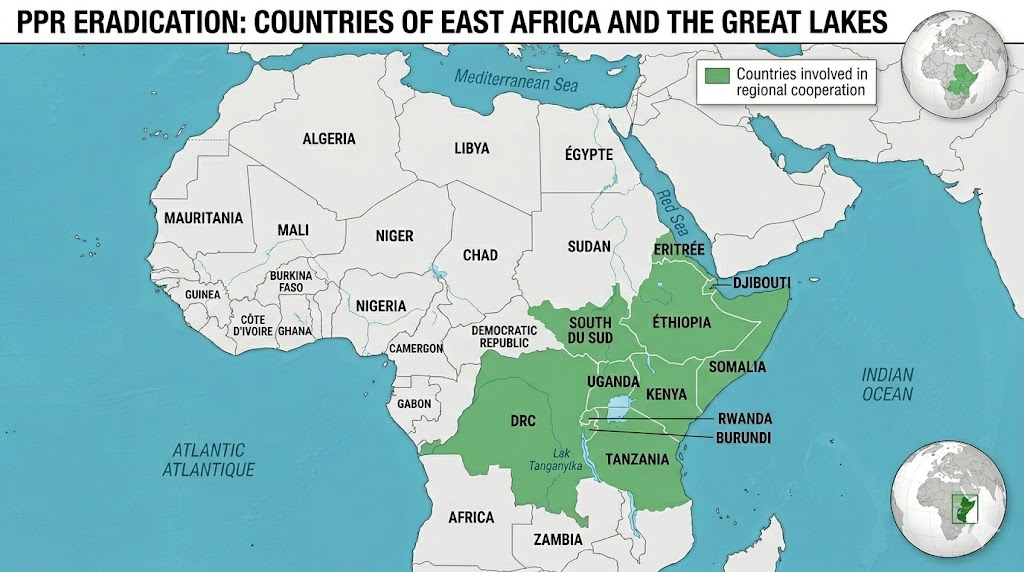
Each country shared its experience, epidemiological situation and available data. Discussions covered animal movements, livestock markets, border areas, vaccination activities, surveillance systems and laboratory capacity.
Through group work, participants began mapping country-specific PPR episystems. These initial maps are an important starting point for more targeted planning and better regional coordination.
The Great Lakes Region: a critical space for coordination
The second part of the meeting focused on cross-border harmonisation in the Great Lakes Region, including Burundi, the Democratic Republic of Congo, Kenya, Rwanda, Tanzania and Uganda.
In this region, livestock systems are deeply connected. Animals move for grazing, trade and community exchange. This mobility is essential for livelihoods, but it can also allow PPR to spread if countries do not coordinate their actions.
Participants identified practical areas for collaboration, including joint surveillance, synchronised vaccination campaigns, improved data sharing and stronger coordination mechanisms.
The message was clear: one country cannot defeat PPR alone if the virus continues to circulate across the border.
Field realities remain challenging
The workshop also highlighted major challenges. These include insecurity, hard-to-reach areas, weak infrastructure, limited veterinary service coverage, financial constraints and insufficient laboratory capacity in some settings.
Another key limitation is the lack of complete animal identification and traceability systems. Without reliable information on animal movements, it becomes harder to know where to vaccinate, where to strengthen surveillance and how to measure progress.
In response, participants stressed the importance of community-based approaches. Livestock keepers, local leaders, traders, value-chain actors and field animal health workers can provide practical information on animal movements and help improve early detection, reporting and vaccination acceptance.
More than an animal disease
PPR is not only a veterinary problem. It is also a livelihood, food security and resilience issue.
When goats and sheep die, families lose income, food, savings and security. For pastoral and rural communities already facing climate stress, conflict or limited access to services, a PPR outbreak can deepen vulnerability.
Eradicating PPR is therefore not only about protecting animals. It is about protecting people, strengthening local economies and supporting more resilient livestock systems.
Turning commitments into action
The Arusha meeting reinforced a shared understanding: to eradicate PPR by 2030, countries must plan together, share data and align interventions with the real movement patterns of animals and people.
The next steps will include stronger episystem-based planning, improved surveillance, harmonised vaccination, better use of monitoring tools such as the PPR Monitoring and Assessment Tool, and continued collaboration through regional platforms.
For AfricaVET, the Arusha workshop marks an important step forward. It shows that PPR eradication will depend not only on vaccines, but also on coordination, trust, data, community engagement and the ability of countries to act together across borders.