



In markets, they monitor food safety, explain hygiene practices, and protect consumers. In villages, they organize community awareness, detect and report risks, and co-design solutions with local actors. In laboratories and civil society organizations, they strengthen capacities, document threats, and support coordinated response. Across Cameroon, women are making One Health real—connecting human health, animal health, and environmental protection—while remaining too often absent from the spaces where priorities, budgets, and strategies are decided.
On the ground, One Health often has a woman’s face
Over the past few years, women-led networks and associations have helped move One Health from policy language to practical action. Their strength lies in working where risk is generated and transmitted: markets, value chains, water points, wildlife–livestock interfaces, and households.
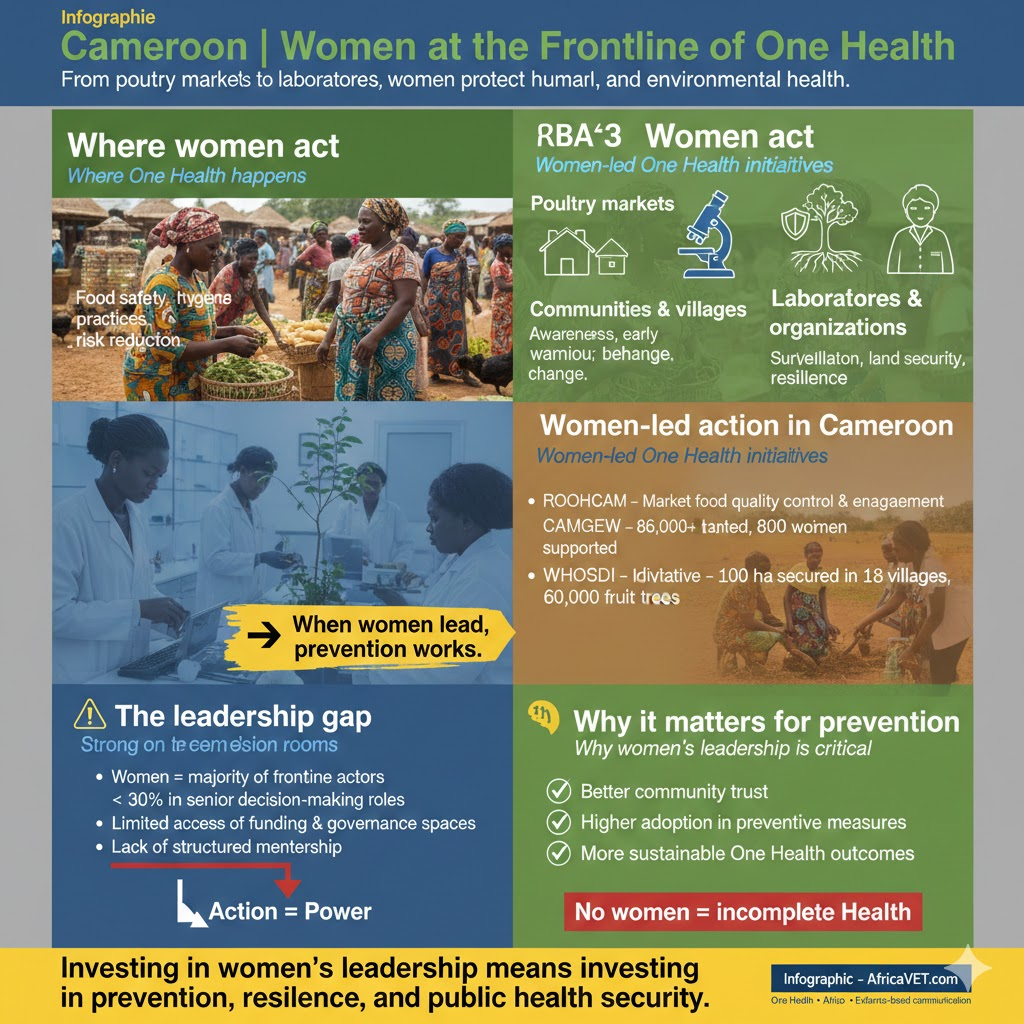
A leading example is Marie Hélène Ebieline, President of the Network of One Health Organizations in Cameroon (ROOHCAM), which has been actively engaged for more than four years. Under her leadership, ROOHCAM—supported by GIZ PPOH—implemented a market-based project focused on quality control of food products. The initiative illustrates a key One Health principle: prevention is more effective when it is anchored in existing community leadership and social trust.
“The fact that most market leaders are women made the initiative well received and helped generate lasting behaviour change. When women get involved, community dynamics shift,” Marie Hélène Ebieline explains.
Environment, resilience, protection: measurable impacts
Beyond food safety, women-led One Health action is also visible in environmental protection and gender-based violence response—two areas closely linked to health risks and community resilience.
Cameroon Gender and Environment Watch (CAMGEW), led by Ernestine Leikeki Sevidzem, has delivered substantial results: over 86,000 trees planted, 800 women survivors of violence supported, and several sustainable livelihood initiatives established in the North-West Region. In parallel, the “Lilagle” initiative enabled many women to secure 100 hectares of land across 18 villages, while promoting food security through the planting of 60,000 fruit trees.
More recently, organizations such as the Women in One Health and Sustainable Development Initiative (WHOSDI) have also emerged, contributing to stronger advocacy and community engagement around integrated health approaches.
Leadership remains the missing link between action and decision
The paradox is clear: women are highly present in implementation, yet less visible in governance. In global health, evidence consistently shows a persistent gap between women’s representation in the workforce and in leadership: women make up nearly 70% of the health workforce, but hold only around a quarter of senior leadership roles.
In Cameroon, these challenges often translate into:
- limited access to decision-making roles and strategic leadership opportunities;
- reduced access to funding for women-led One Health initiatives;
- under-representation in multisectoral coordination mechanisms;
- insufficient mentorship pipelines and professional networks for young women across human health, veterinary, environmental, and social science disciplines.
As Nicole Fouda Mbarga, President of WGH, stresses:
“One Health without women is an incomplete equation. We urgently need to institutionalize gender parity in One Health governance bodies and earmark funding for women-led projects or projects that integrate gender equality.”
For Marie Hélène Ebieline, the challenge is also conceptual: gender is still too often treated as a checkbox rather than a driver of performance and accountability.
“If gender, in its full meaning, considered all realities, we would see more women in decision-making spaces… This is a moment to advocate for more women in leadership positions to accelerate One Health outcomes,” she argues.
Why it matters for prevention
One Health prevention depends on three essentials: trust, adoption, and continuity. Women are often central to the community influence networks that shape these essentials—market committees, households, informal trade systems, local associations, and cooperatives.
Strengthening women’s leadership is therefore not just a fairness agenda. It is a practical governance choice that can improve early warning, increase acceptability of measures, and make One Health investments more effective and durable.
Image : Cameroon One Health Plateform, Jan., 2026