


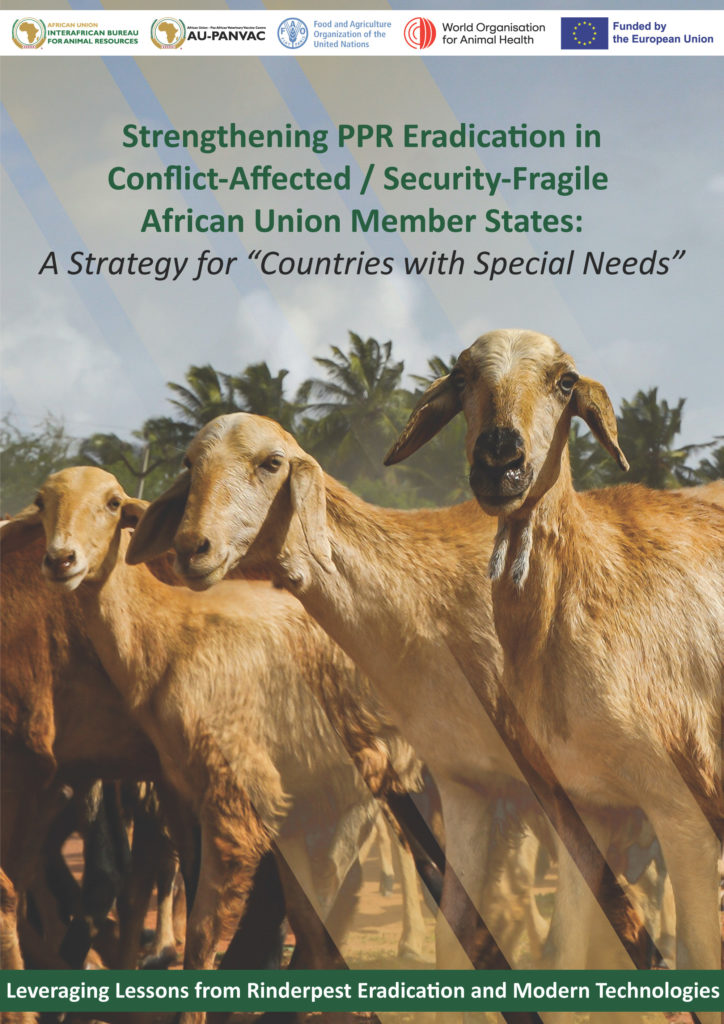
Hosted within AU-IBAR, the Pan-African PPR Secretariat (PAPS)—with technical support from AU-PANVAC, FAO and WOAH—has released a new strategic publication addressing one of the hardest questions in animal health: how can Africa eradicate Peste des Petits Ruminants (PPR) in conflict-affected and fragile settings without leaving communities behind? Backed by the European Union, the paper proposes a conflict-sensitive pathway to keep the continent on track for PPR eradication by 2030, drawing on lessons from the successful eradication of rinderpest and leveraging modern technologies.
Why PPR persists in fragile and conflict-affected contexts
The publication starts from a practical reality: where insecurity is protracted—through armed conflict, displacement, disrupted markets and weak local governance—routine veterinary services struggle to operate, surveillance becomes intermittent, and vaccination coverage drops. Yet in these same settings, sheep and goats are often the last protective asset for households, providing food, cash, and rapid recovery after shocks. When PPR strikes, it can accelerate food insecurity, malnutrition and income loss, with especially severe impacts on women and children.
In short, the “standard” playbook—stable access, predictable campaigns, continuous supervision—does not consistently work where access is limited, populations are mobile, and risk fluctuates. That is why the paper argues for a more adaptive, inclusive and conflict-aware approach.
A three-pillar approach for adaptive implementation
1) Conflict-sensitive programming: flexible, mobile, coordinated
The first pillar is operational: adapt delivery to insecurity rather than pause delivery because of insecurity. Recommended options include:
- mobile vaccination and surveillance teams that can deploy rapidly during access windows;
- lighter operational footprints to reduce exposure and maintain continuity;
- structured use of Community Animal Health Workers (CAHWs) and other local intermediaries to sustain frontline delivery where public services cannot remain present;
- vaccination corridors aligned with transhumance routes, livestock markets and key trading axes—sometimes linked to negotiated “days of tranquillity” or local access arrangements.
The paper also stresses the need for coordination across systems: veterinary authorities, local administrations, NGOs/CSOs and humanitarian actors should operate from a shared plan that aligns access, security constraints, and community priorities.
2) Trust and community ownership: inclusion as a condition for effectiveness
The second pillar is social and political: eradication cannot be achieved if communities perceive campaigns as intermittent, unfair, or externally imposed. The publication places strong emphasis on:
- engaging traditional and religious leaders as trusted conveners;
- strengthening participation of women’s and youth groups, not only as beneficiaries but as contributors to mobilization, outreach and feedback;
- ensuring two-way communication and accountability—communities should be able to report concerns, access issues and adverse events, and see how programs respond;
- integrating PPR interventions with broader livelihood and community resilience actions where feasible, so that “animal health” is not treated as an isolated vertical programme.
The core message is clear: in fragile settings, trust is a delivery system. Without it, coverage and reporting collapse—precisely what allows PPR to persist.
3) Technology-enabled resilience: detect faster, trace better, respond smarter
The third pillar calls for “21st-century tools” to strengthen delivery under constraints. Proposed measures include:
- mobile-based surveillance and reporting to reduce delays and improve situational awareness;
- risk-focused surveillance (“intelligence-led”) targeting mobility corridors, markets and congregation points;
- remote sensing and satellite-informed monitoring to anticipate mobility patterns and environmental drivers that influence disease spread;
- stronger vaccination traceability and certification, including digital options aimed at protecting data integrity and enabling credible coverage reporting in difficult operating environments.
In practice, the paper positions technology not as a luxury, but as a way to compress time—shortening the interval between detection, response and verification.
Why NGOs and civil society organisations matter for the “last mile”
A dedicated section highlights the operational role of NGOs/CSOs in hard-to-reach areas. The paper argues that these actors can provide:
- sustained community presence and established trust networks;
- faster deployment in settings where state structures face constraints;
- strong community engagement capacity (risk communication, behaviour change, mobilisation);
- logistical agility and local access expertise.
However, the message is not “replace public services.” Instead, the publication recommends structured partnerships that build durable capacity: training and equipping CAHWs, strengthening local organisations (including women and youth associations), and aligning monitoring and reporting so that NGO-supported delivery becomes part of the national and continental pathway.
What this pathway aims to change by 2030
The publication’s ambition is to ensure that fragile and conflict-affected countries do not become the permanent “holdouts” that jeopardise continental eradication. It seeks to:
- expand the reach of surveillance and vaccination in high-risk areas;
- build more reliable coverage through community-centred delivery and trust-building;
- prevent exclusion by ensuring that “difficult contexts” remain inside the eradication strategy, not outside it;
- transform fragile settings from a “last-mile trap” into an area of accelerated, targeted gains.
The final call is for operationalisation at scale: dedicated financing, strong political backing, robust coordination, and a delivery model that can adapt continuously as security and access conditions evolve—under AU leadership through AU-IBAR/PAPS, with AU-PANVAC, FAO and WOAH as key technical partners, and with sustained partner support.
Download the documents: