


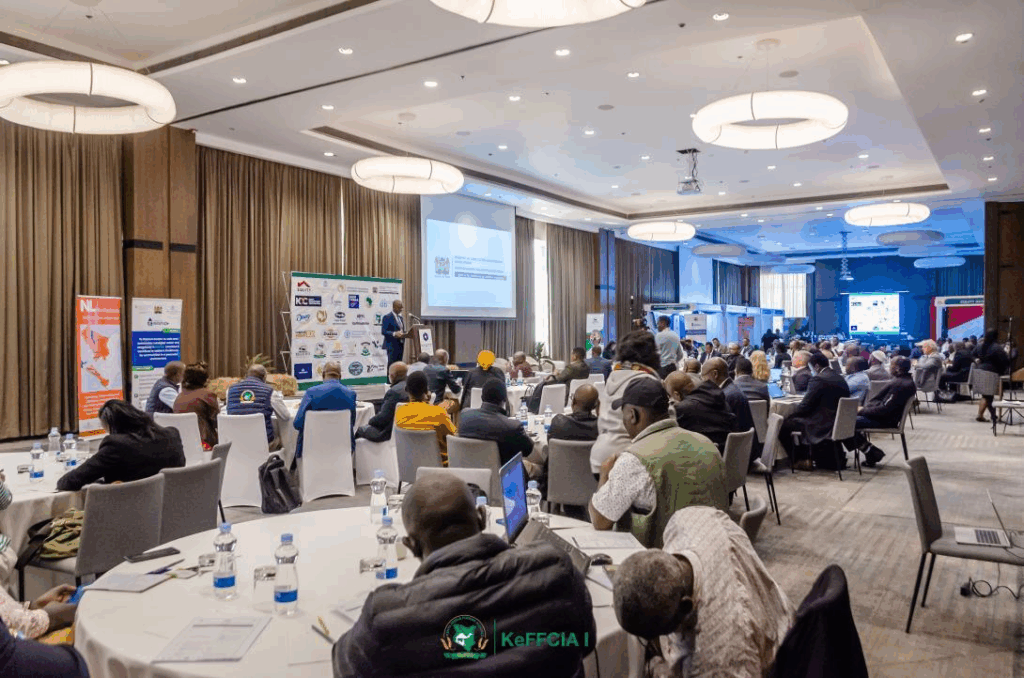
Kenya’s livestock sector has entered a significant new phase of resilience and investment with the successful convening of Kenya’s First Fodder Contracting and Investment Action (KEFFCIA). Organized by the Kenya Feed and Fodder Alliance (KEFFA), in partnership with AU-IBAR and the State Department of Livestock, the event gathered over 150 key stakeholders, including cooperatives, ASAL counties, fodder enterprises, financiers, and development partners, to shape a new direction for the industry.
A major focus of the forum was the introduction of two flagship financing innovations designed to transform fodder production into a sustainable, investable sector. The first, the Cooperative Fodder Fund (CFF), is a cooperative-led financing model that enables dairy farmers to self-fund the production and preservation of fodder. By allocating a small levy from milk collections, cooperatives can build secure feed reserves and operate local feed centers for harvesting, storing, and distributing feed. This approach helps to buffer farmers against recurring milk supply shocks during droughts, which can result in cooperatives losing up to 100% of their intake and threatening the stability of both livelihoods and processors. Through the implementation of the CFF, cooperatives gain control over their feed supply, lower dependence on expensive credit, and highlight fodder production as an attractive area for investment.
The second innovation, the Sustainable ASAL Fodder Economy (SAFE) Fund, is designed specifically for arid and semi-arid lands. County leaders endorsed this slaughterhouse-anchored, levy-based financing mechanism, which involves charging a small fee for each animal slaughtered. The collected funds are then used to finance upstream fodder production, build feed centers, and invest in climate-resilient infrastructure. In the wake of Kenya’s estimated loss of 2.5 million livestock during the 2021–2022 drought, the SAFE Fund represents a proactive shift from emergency relief to county-driven resilience. Counties committed to legally anchoring the fund, managing it transparently, and integrating it with local feed emergency and climate adaptation strategies.
KEFFCIA is now positioned to become an annual forum for accountability and investment in Kenya’s fodder sector. By championing the Cooperative Fodder Fund and the SAFE Fund, the event showcased how local resource mobilization and structured partnerships can secure the future of Kenya’s livestock industry. As AU-IBAR’s Director noted, “If we fix feed, we fix food.” These new financing models offer Kenya a decisive step forward in protecting livelihoods, increasing livestock productivity, and positioning fodder as a cornerstone of both food security and economic development.
Source : AU-IBAR, 2025