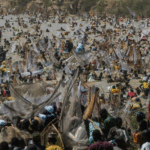



The Atlantic and Mediterranean waters off North and West Africa have long been the lifeblood of coastal economies, providing a primary source of protein for millions and supporting a multi-billion dollar industry. However, by early 2026, the sector has reached a critical tipping point. New data and regional policy shifts reveal a stark reality: the industry is currently caught in a pincer movement between collapsing fish stocks and the persistent scourge of Illegal, Unreported, and Unregulated (IUU) fishing.
The Safi Shock: A Port in Crisis
Nowhere is the economic fragility of the sector more visible than in the Moroccan port of Safi. Recent statistics from January 2026 paint a sobering picture of a “silent crisis” becoming a loud alarm. Landings of coastal and artisanal fishing products at Safi plummeted by an astounding 93% in volume and 74% in value compared to the same period in 2025.
The breakdown of these figures is particularly alarming for the region’s economic stability:
- Pelagic species: Once the backbone of the local industry, landings crashed from 1,741 tonnes to a mere 4 tonnes.
- Cephalopods (Octopus/Squid): Revenue dropped by over 70%, directly impacting the high-value export market.
- White fish: Volume decreased by 53%.
While national revenues in Morocco showed a slight 5% increase due to higher market prices, the 21% national drop in catch volume indicates that the industry is working harder for less. This “scissors effect” rising costs and dwindling resources is pushing small-scale fishers to the brink of insolvency.
The CSRP’s New Offensive
South of Morocco, the Sub-Regional Fisheries Commission (CSRP), headquartered in Dakar, is spearheading a renewed regional strategy to combat the primary driver of this decline ((IUU fishing). In a high-level briefing this February, the CSRP’s Permanent Secretary emphasized that illegal fishing is no longer just a maritime security issue; it is a direct threat to the “Blue Economy” of West Africa.
To counter this, the CSRP is deploying a more aggressive, technology-driven roadmap for 2026:
- Enhanced Intelligence Sharing: Moving beyond simple patrols, member states (including Senegal, Mauritania, and Guinea) are integrating satellite monitoring with port-side traceability systems to “blacklist” vessels before they even dock.
- Harmonized Access Conditions: The CSRP is pushing for stricter “Minimum Access Conditions,” ensuring that foreign industrial fleets cannot exploit legislative loopholes to overfish in territorial waters.
- Cross-Border Task Forces: Learning from successful regional models, new task forces are being established to conduct joint surveillance, effectively removing the “blind spots” at maritime borders where illegal trawlers often hide.
Economic Survival vs. Long-term Sustainability
The current landscape reveals a profound tension. For governments, there is an immediate need to protect the 15% of West Africa’s GDP that relies on fishing. Yet, the data suggests that without radical conservation, there will be no industry left to protect.
Environmental experts point to the “chronic overexploitation” of small pelagics-fish like sardines that form the base of the marine food web. As these stocks vanish, not only do local fishers lose their livelihoods, but the risk of “illegal migration” increases, as documented in recent regional reports linking fishery collapse to the displacement of coastal populations.
The Path Forward
The crisis at Safi port and the CSRP’s strategic pivot represent two sides of the same coin. Sustainability is no longer a luxury of environmental policy; it is the prerequisite for economic survival.
For the region to recover, the response must be twofold: rigorous enforcement to end the “black hole” of illegal fishing, and science-based management that respects biological rest periods. As we move further into 2026, the success of these measures will determine whether North and West African waters remain a source of prosperity or become a cautionary tale of ecological and economic exhaustion.