


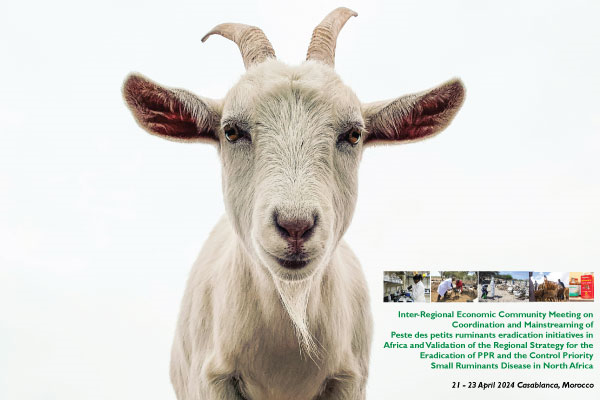
The worldwide effort to combat Peste des Petits Ruminants (PPR) is about to reach a defining moment with the upcoming Inter-Regional Economic Community Meeting. The event, organized by AU-IBAR and the Arab Maghreb Union (UMA) will take place in Rabat, Morocco, from April 21st to 24th, 2024, with the objective of coordinating and mainstreaming eradication efforts throughout Africa. At the meeting, one of the main goals is to validate the North African Regional Strategy to Control Priority Small Ruminant Disease and Eradicate PPR. In the ongoing global drive to eradicate PPR from the continent, this gathering is shaping up to be a crucial occasion.
Building on the momentum generated since the approval of the PPR Global Control and Eradication Strategy (PPR GCES) in 2015, stakeholders are poised to make significant strides. The first five-year PPR Global Eradication Programme (PPR GEP) laid the groundwork, and insights gained during this period have informed the development of operational guides, such as the Blueprint for PPR Eradication by 2030 (PPR GEP II and III), launched in 2022. As participants convene in Rabat, they are expected to review progress, share lessons learned, and chart a course for future action in line with global and continental strategies.
Prioritising this issue in continental policies and programmes demonstrates the African Union’s unwavering commitment to eradicating PPR. The Pan-African Programme for the Eradication of PPR (2023–2027) and the Pan-African Strategy for the Eradication of PPR and the Control of Other Priority Small Ruminant Diseases offer a thorough plan of action. The formation of the Pan-African PPR Secretariat (PAPS) by AU-IBAR in coordination of these activities is a clear indication of the continent’s will to fight PPR comprehensively.
To propel regional prosperity, Regional Organisations and Regional Economic Communities (RECs) are expected to play pivotal roles. Regional strategies will be in line with continental objectives owing to the leadership, cooperation, and coordination provided by these entities. Egypt and the other member states of the Union Magreb Arab (UMA) are expected to work together to validate the North African Regional Strategy. To ensure the strategy is relevant and successful in addressing regional concerns, stakeholders have contributed to its refinement and finalisation through consultative processes and workshops.
The three-day Inter-Regional Economic Community Meeting on PPR Eradication in Africa has an extensive programme covering a wide range of issues with the goal of increasing eradication efforts. Session topics on day one centre on outlining PPR frameworks throughout Africa, including the Pan African PPR Eradication Programme, the PPR Global Blueprint, and regional PPR plans and initiatives. The second day is devoted to PPR control and eradication efforts in Africa. Topics covered include interventions by the FAO and WOAH, funding from the EU, and actions by RECs. Sessions on developing roadmaps for PPR eradication, coordinating and harmonising PPR control activities, and jointly mobilising resources are also on the agenda. Agreements are finalised, communiques are drafted, and deliberations are concluded on the last day. Group projects, presentations of national and regional strategies, and the acceptance of the strategy are all part of the agenda’s sessions devoted to validating the Regional Strategy for the Eradication of PPR and other priority Small Ruminant Diseases in North Africa. The schedule also includes a stop at the MCI Laboratory for a guided tour.
The attendees at the Inter-Regional Economic Community Meeting on PPR Eradication in Africa represent a diverse range of organizations and institutions dedicated to combating Peste des Petits Ruminants (PPR). Among them are representatives from AU-IBAR, AU-PANVAC, UMA, RAHC/ECOWAS, RAHC/ECCAS, LTC-SADC, IGAD/ICPALD, EAC, VSF Regional Africa, Red Cross regional Africa, ILRI, IAEA, FAO regional and sub-regional Office (RAF), WOAH Regional Office for Africa, FAO PPR Global Secretariat, and others such as AfDB, BMGF, DTRA, GalvMed, EU, and IsDB. The meeting will also include attendees such as the Comité Vétérinaire Maghrébin Permanent, Chief Veterinary Officers (CVOs) from Tunisia, Algeria, Libya, Morocco, Mauritania, and Egypt, PPR National Coordinators from the same countries, representatives from Réseau Méditerranéen de Santé Animale (REMESA), and various other regional organizations and partners from development and civil society sectors, including Farmers/traders associations.
Stakeholders hope for a recommitment to PPR eradication initiatives when the Inter-Regional Economic Community Meeting takes place. Participants may speed along the path to a future without PPR by working together, coordinating their efforts, and confirming regional approaches. In the face of intractable global problems, such endeavours demonstrate the best of international cooperation and unity. Stakeholders will leave the meeting with a more defined strategy and a stronger commitment to combat PPR throughout Africa.
Source : AU-IBAR, 2024