


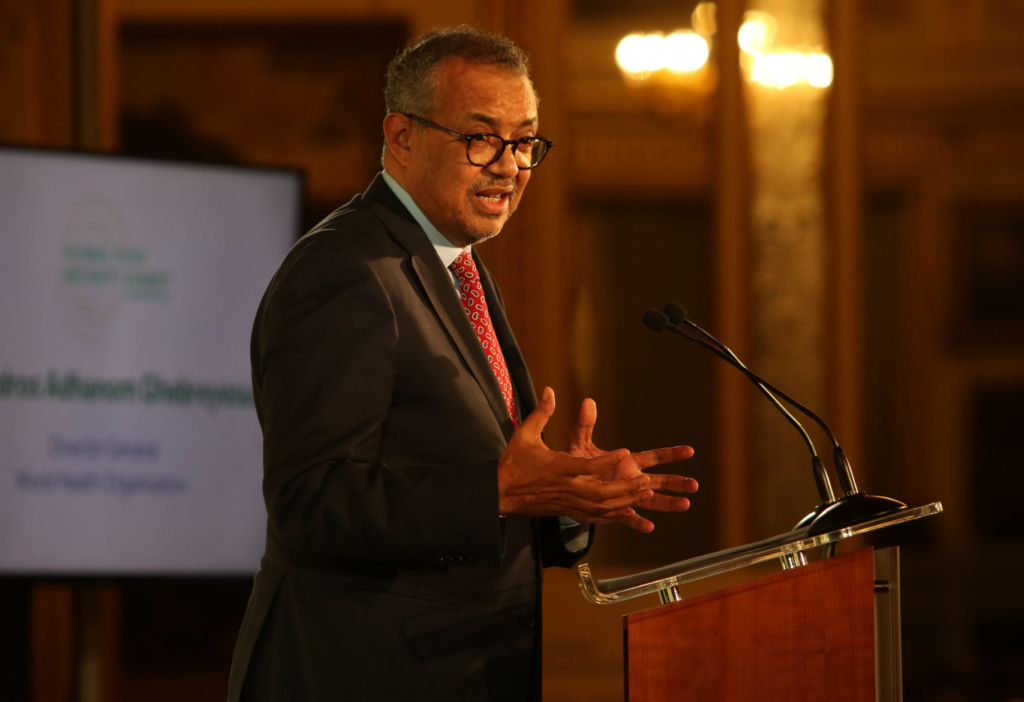
Good morning, good afternoon and good evening,
Mpox has been reported in the Democratic Republic of the Congo for more than a decade, and the number of cases reported each year has increased steadily over that period.
Last year, reported cases increased significantly, and already the number of cases reported so far this year has exceeded last year’s total, with more than 14 000 cases and 524 deaths.
As many of you who tune into our regular press conferences know, WHO has been working on the mpox outbreak in Africa and raising the alarm that this is something that should concern us all.
Last week I announced that I was convening an Emergency Committee under the International Health Regulations to evaluate the upsurge of mpox in the Democratic Republic of the Congo and other countries in Africa.
Today, the Emergency Committee met and advised me that in its view, the situation constitutes a public health emergency of international concern. I have accepted that advice.
The detection and rapid spread of a new clade of mpox in eastern DRC, its detection in neighbouring countries that had not previously reported mpox, and the potential for further spread within Africa and beyond is very worrying.
In addition to other outbreaks of other clades of mpox in other parts of Africa, it’s clear that a coordinated international response is essential to stop these outbreaks and save lives.
A public health emergency of international concern is the highest level of alarm under international health law.
The Emergency Committee’s advice to me, and that of the African Centres for Disease Control and Prevention, which yesterday declared a public health emergency of regional security, are aligned.
WHO is on the ground, working with the affected countries, and others at risk, through our country and regional offices, as well as with partners including the Africa CDC, NGOs, civil society and more.
For example, we are providing machines to analyze blood samples and confirm cases of mpox;
We’re supporting laboratories to sequence viral samples;
We’re on the ground supporting case investigation and contact tracing, risk communication and community engagement;
We’re training health workers and supporting clinicians to provide appropriate care;
We’re supporting countries to access vaccines and develop the strategies to roll them out;
And much more.
To fund this work, WHO has developed a regional response plan, requiring an initial US$ 15 million.
We have released about US$ 1.5 million from the WHO Contingency Fund for Emergencies, and we plan to release more in the coming days. We are also appealing to donors to fund the rest of the response plan.
WHO is committed in the days and weeks ahead to coordinate the global response, working closely with each of the affected countries, and leveraging our on-the-ground presence, to prevent transmission, treat those infected, and save lives.
I thank the Emergency Committee for its work and advice, and I would like to give the floor to Professor Dimie Ogoina, the Chair of the Emergency Committee, to summarize the Committee’s considerations.Professor Ogoina, you have the floor.
OMS, 2024