


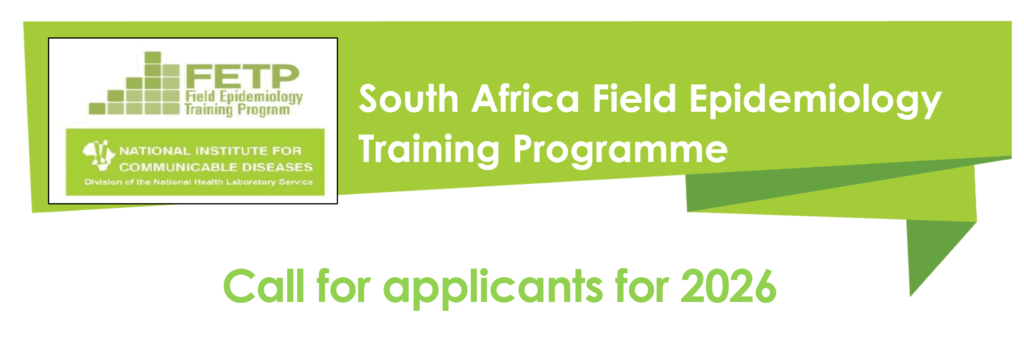
The South African Field Epidemiology Training Programme (SAFETP) is now accepting applications for the 2026 class, from qualified health professionals with an interest in public health and a commitment to public service.
Field Epidemiology Training Programmes (FETPs) have been established in many countries around the world to provide training and develop competencies that are essential for effective disease detection, investigation, control, and prevention, with a goal of enhancing the health security of communities. FETP trainees spend a maximum time (75%) in the field, and 25% in the classroom, where they develop practical skills to collect, analyse, and use data to address priority public health issues
and inform policy.
The South African FETP is hosted by the National Institute for Communicable Diseases, a division of the National Health Laboratory Services for the National Department of Health . SAFETP offers a full-time two-year residency programme, which provides training and practical experience in applied epidemiology, and aims to develop specialist skills to evaluate and strengthen public health surveillance systems, investigate and control outbreaks, and conduct field studies to address public health priority issues.
Training is provided mainly through on-the-job service provision and learning activities. A trainee who successfully completes the programme is awarded a Master of Science (MSc) degree in Field Epidemiology from either the University of Pretoria or the University of the Witwatersrand.
The next cohort of trainees will begin in January 2026 and end in December 2027. Qualified professionals who are interested in joining the cohort should submit their applications before 01 July 2025.
Applicants who are funded by their employers must ensure that this funding covers their salaries/stipends, as well as university registration and tuition fees for the two-year training period.
Applicants currently working within the South African government at various levels, who plan to take study leave to participate in the programme and afterwards return to their workplace, must have written approval from their departments.
A limited number of bursaries/scholarships may be available for selected applicants fulfilling predefined criteria.
Limited places may be offered to applicants from selected Southern African countries who meet the entry requirements, and are supported by their governments. Such applicants must be eligible for the required visa/permit to study in South Africa. The applicant must also ensure that their employer/government has agreed to fully cover the costs related to their participation in SAFETP for the two years of training – including salaries/stipends, university registration and tuition fees, living expenses while studying
in South Africa.