


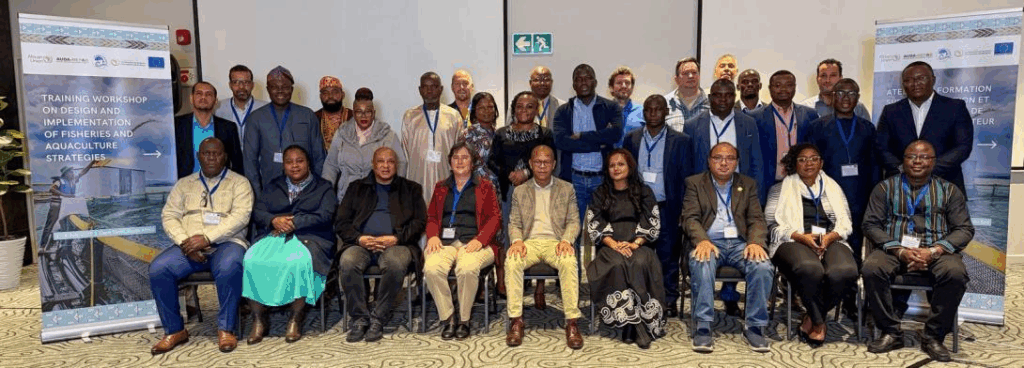
From July 2–4, 2025, a high-impact training workshop on developing and implementing fisheries and aquaculture strategies was held in Cape Town, South Africa—bringing together AU Member States to strengthen national planning capacities. This event was convened under the leadership of the African Union, with the support of AUDA-NEPAD, AU-IBAR, under the FishGov2 Project, funded by the European Union, and anchored in the Policy Framework and Reform Strategy (PFRS) for fisheries and aquaculture in Africa.
The purpose of the workshop was to equip African countries with the practical tools, frameworks, and methodologies needed to design coherent, inclusive, and results-driven strategies aligned with PFRS, the African Blue Economy Strategy, and the CAADP Kampala Strategy and Action Plan (2026–2035).
Dr. Bernice Mclean of the AU’s Directorate of Agriculture, Food Security, and Environmental Sustainability opened the workshop, emphasizing that:
“Across our continent, fisheries and aquaculture are not only vital to food and nutrition security but also to employment, trade, and climate resilience… Yet they remain under-optimized.”
The workshop’s agenda was participatory and outcome-oriented—beginning with foundational insights on the purpose and structure of strategies. Noted experts including Bara Déme, Pierre Failler, and Hashali Hamukuaya guided sessions on aligning national strategies with the PFRS and continental policy frameworks. Country teams from Mauritania, Burundi, Mauritius, South Africa, and Tunisia showcased case studies, helping frame real-world applications of policy formulation.
Through hands-on sessions, country teams drafted national visions, defined key priorities, conducted diagnostics, and shaped implementation plans. Special focus was given to stakeholder roles, governance structures, financing mechanisms, and institutional arrangements essential for sustainable roll-out.
By the end of the three days, participating teams had developed tailored action plans, received technical feedback, and built stronger networks for ongoing collaboration. The workshop reinforced the African Union’s commitment to scaling up strategic planning capacity and ensuring that national and regional efforts align with Africa’s Agenda 2063.
As Africa navigates the twin challenges of climate change and resource depletion, this training marked a critical step forward in building resilient and productive aquatic food systems. It exemplifies the PFRS in action—supporting countries to unlock the full potential of their fisheries and aquaculture sectors for a sustainable and prosperous Africa.
Source : AU-IBAR, 2025